25 September 2010

Thinking about food last night

I was thinking a lot about food at a remarkable concert by The Bad Plus last night. I can taste food, taste a dish and notice a seasoning, an influence, a remarkable combination of ingredients. A good reuben, a classic coq au vin, a 9x13 pan of baked macaroni and cheese, a single thick slice of a sun-warmed Brandywine tomato, a bowl of cereal before bed – every dish offers up something for which we delight, give thanks, and dig in. Food nourishes and gives, reminds us of our need for sustenance and soul, for fellowship as well as calories. The traditions of France, Thailand, and Vietnam, the serendipity of leftovers in the fridge, the strength of oatmeal on a cold morning, the joy of a quick lunch with my wife – these are the things of food, the stories and the context for what we eat and why we eat. There are stories and harmonies and seasons that play off one another, ingredients that shine or support, stand out or blend in.
I’m not trained in music; I know nothing formal about it at all, and I listen to very little recorded music. But live music is different, and though I don’t hear nearly enough of it, most live shows I go to send my soul flying. The few and far between shows of the past year have included the Dave Rawlings Machine, the Takacs Quartet, and last night’s show by The Bad Plus. I’m least familiar with jazz, especially new, cutting edge jazz, and before the show started I was wondering how to listen to it, wondering if there was a way to listen to music that was like tasting food or drinking wine. If there are similarities, I'd say both require attentiveness, a willingness to notice things, an ability to be surprised, an open mind, and flexibility. I started listening to the amazing drummer Dave King and I thought to myself, sure, he’s roasting the bones I’ll use to make my stock. He was wild, hitting the drums and cymbals with intensity, speed, and a lightness that bedeviled my eyes – how did all that movement result in such a light, clean sound followed by a power surge that stood my hair on end? Look, I said to myself, there’s the bassist steadying the universe with his string-pulled throbs, with his leeks, reducing wine to better define the edges of bone and char. I listened and I thought of food, and that let my ears relax so I didn’t work too hard to try to hear something that may or may not be present. Just like food, I thought. Enjoy it, taste it, sniff it and savor it. Ethan Iverson’s piano playing was a real engaging conversation, a collaborative energetic and joyful noise, one that pounded and touched those big Steinway strings in so many ways I didn’t know how he did it himself. And all the time I’m listening I’m thinking to myself, so this is jazz, this constant rearrangement of the ordinary, an extension of something small, a noticing, a wild exuberance that stretches and reaches and stops and there I was with my ears on high and I thought, I want to make a Bad Plus rabbit stew, a fat-wrapped rabbit with a deep black sauce, a red wine and chocolate and red pepper black pepper stew that’ll go with some kind of pasta – maybe thick, maybe thin, I don’t know. We’ll see what the fall brings. Last weekend I butchered eleven big rabbits and tomorrow we’re going to the Cities. Maybe we’ll stop at an Asian market and buy a big slab of pork belly and I’ll start next weekend’s stew.

10 September 2010

September 1, 2010 Radio Show

Jessica Paxton joined me in the studio for the September 1 broadcast of Duck Fat and Politics and we talked about all things Minnesota.

August 11, 2010 Radio Show

The August 11 broadcast of Duck Fat and Politics was especially enjoyable because my wife Meaghen joined me in the studio and we talked about food and cooking and gardening.

Summer 2010

We ended our summer in northern Minnesota, where each year we fish, play cards, swim, and sauna.  One night we sat around a fire and my daughter roasted marshmallows for us.  What a lovely night.

I've written this blog because I love to share food and talk with friends about tomatoes, sauerkraut, chickens and beets.  But one season blends into the next and as this summer progressed I found myself unable to say anything else about the glorious Brandywine tomatoes I was slicing and eating, about the blood red beets we forked from the bowl at dinner time, about the rich yolks of our backyard hens.  Additionally, as I read the 17 million other food blogs that also celebrate confit, ramps, and the ineffability of good zinfandel, I am bowled over by how many good writers and excellent photographers have surpassed my parochial interests and limited writing skills.  Food is such a hot topic that I'm seeing some of the writing moving toward the competitiveness we see in sports, fashion and other interests and I wonder if we're all really and truly interested in piment d'esplette peppers or if we're searching them out because no one else has written about them yet?  Do we enjoy slaughtering animals or are we trying to outdo the next writer who merely bought his sow's belly at a butcher's market?  Me?  I got my piment d'esplette seeds from a guy in Vancouver because I had read about the pepper for years and met a fellow blogger who is from the region in France where they're grown, and she knew the guy with the seeds.  So while there may be a back story to the things we cook and eat and write about, it's easy to seem like a carpetbagger.  So, all summer I've avoided writing, spending the time instead with family and friends, doing the things I usually do, and eating delightful things.  I still have to figure out how to move past this awkward stage of my blog, where I've written about the foods and traditions I care about and don't want to be too repetitive.  At the same time, I've missed writing and sharing the stories of food and the way it connects us as a family and as part of a community.  

19 July 2010

Fried walking catfish with fried holy basil


This dish is as evocative of southern Thailand as any food I know. The village where I lived and worked was in the midst of southern Thailand's vast acreage devoted to rubber trees; what once was lowland rain forest had been cleared to make room for the long neat rows of rubber trees. Poor by any standard used in the United States, these rubber farmers felt the swings in worldwide rubber prices, and while their rubber trees gave them an opportunity to make more money than rice farmers, they continued to subsist on the foods they grew, foraged, or caught. Most yards had papaya trees, chili peppers, lemon grass, kaffir limes, galangal, ginger, tumeric, and an wide array of herbs, leaves, and other plants used for cooking. I often didn't know which planted were cultivated and which were wild.
The correct fish for this recipe is walking catfish, (although pla duk, ปลาดุก is also translated simply as "catfish,") easily caught in the streams of southern Thailand, but an unwanted, illegal, invasive species here in the US. I found them frozen in an Asian market in Minneapolis; the frozen fish cost $3.50. They remind me of bullheads, which could be used; so could any small catfish. Clean the fish, cut off their heads, and slice them into 1" chunks.
Holy basil (Ocimum sanctum, kha phrao, กะเพรา) can be grown as easily as other varieties of basil, and it's specifically used in a number of Thai dishes, so you might want to plant a little of it in your garden. This recipe calls for a lot; I like to pick a colander full, maybe 4 cups of leaves.
Fresh curry paste makes this dish sing.  The curry paste is fried in a little oil, intensifying its flavor (and its fragrance, which is why I try to cook this outside, especially because of the frying involved.)
Palm sugar is the last thing needed, and a few tablespoons will be enough.

So here's how I make this delicious curry:
I lit my Weber Smokey Joe and when the charcoal was hot I put my dutch oven on top, and filled it with about 2" of oil.  When it got to 400 degrees F. I slipped in the pieces of catfish and fried them until they were crisp. I removed them with a slotted spatula and put them on a brown bag.
Next, I fried the basil leaves.  After I picked them I brought them into the kitchen and pinched all the leaves off their stems, so only leaves remained.  They went into the hot oil and cooked almost immediately.  In less than a minute, after swirling them once through the oil, I used the spatula and put the crisp leaves in a brown bag to drain.
I poured the oil into a glass jar, leaving only a few tablespoons on the bottom of the pot.  Returning the pot to the heat, I put in the 1/2 cup or so of curry paste, and stirred it, watching it brown and cook.  To this I added a few tablespoons of palm sugar, and tasted it to make sure I noticed the sweetness. Before the curry paste had a chance to burn, I added a little water, which sputtered furiously in the intense heat of frying curry paste.  I kept stirring, and eventually it smoothed out like a nice roux.  I added enough water to make it like a thick sauce, less than a cup, but every time I make this I think I should add a little more water because then maybe we'd have a little more leftover sauce, which is great with rice for lunch the day after.
To this bubbling brew I now returned the crispy fried slices of catfish, and stirred to mix the fish into to sauce.
On the heels of the catfish came the basil, and to the pot I now added 1/2 the basil, stirring it in gently, letting the crisp basil find its way into the mix.
When all was well and good I ladled it into a serving bowl and topped the entire thing with the second half of the crisp fried basil.  What a sight!
We brought this to the table with fresh green beans and a lot of rice.  Oh, and a few grilled hot dogs, too!  This dish is way too spicy for our kids, and they were happy to eat Twins Ballpark hot dogs, the big fat ones.
I hope you'll take the time to make this curry; it's one of my favorite dishes.  The curry sauce is fiery hot with a little sweetness, and the basil is infused throughout. Some of the basil loses its crispness, but by keeping some of it on top of the curry, every spoonful can bring a crisp bit with it.  The catfish is a rich, oily fish, and it retains its flavor while surrounded by other strong tastes.  'Roi jahng hoo! as they'd say in Trang.

16 July 2010

July 14, 2010 Radio show

Wednesday's broadcast of Duck Fat and Politics was preceded by an afternoon of fierce weather, with several small tornadoes touching down within a few miles of Northfield, one of which was visible from the Carleton College campus.  My guest on the show was Lynne Wilmot, whose chemical sensitivity has led her to live and eat as chemical- and toxin-free as she can.  The show was recorded and is available for your listening pleasure!

13 July 2010

June 30, 2010 radio broadcast

I ended the month of June with a Duck Fat and Politics radio show that featured my sister Bridget, who's lived in Sitka, Alaska for seventeen years.  We talked about food and fishing in southeast Alaska.  I hope you enjoy listening!

June 23, 2010 radio podcast

Here's the recording of the June 23rd Duck Fat and Politics radio show with me and my two daughters in the studio.  We had a nice conversation about the eating habits of kids.  I hope you enjoy listening.

How does it get to this?


What started as a few rabbits for dinner became, over time, a reduced, softened and taste-enhanced mess of flavor, a fragrant and humble end to a long set of meals.

Here we are with warm days and evenings filled with soccer and baseball and sometimes weeding in the garden. Fancy meals are a rarity now; what we eat instead is fresh, simple, and easy to prepare. My youngest sister recently visited from Sitka, Alaska with her family, and I wanted to give them a taste of Minnesota in the summer. Admittedly, I’m envious of the range of fish they catch and regularly eat, but I love the food that we pull from our garden daily.

We started them with wide-cut pasta, an egg-rich dough we rested for hours before rolling it out, soft, pliable and generous. A simple tomato sauce and a garden-fresh green salad made for a meal within easy reach.

As the weekend started I cut up a few rabbits and made a nice stock with the bony parts, the base for Saturday night’s rabbit risotto with fresh snap peas. The rabbit pieces marinated for a few days with a rub of garlic, bay leaves, crushed juniper berries, black pepper, and salt. Visiting family members make great kitchen helpers, and I was happy to turn the risotto stirring over to my brother-in-law. As Randy stirred, I cut a tenderloin into thin pieces that cooked in minutes. With a last minute addition of both shelled and in-the-pod snap peas, the creamy risotto was flecked with bites of green freshness.

And finally this evening, just me and my daughter on a soccer night.  A few thin leeks from the garden, sauteed in a little olive oil and fat.  A big spoonful of whole wheat flour to darken and thicken the juices.  And finally, the remains of the day, old slow cooked pieces of rabbit, now dissolved like pulled pork.  And tender, meltingly so.  A scoop and the brown jelly bits dissolve and splatter, thickening in the heat and almost-roux.  Tarragon, a little milk, salt and pepper.

And off to the side in the shallow bowl, the bits of green?  Oh, a little savoy cabbage from a friend's CSA share that he couldn't use this week because they were on vacation.  So I cut thick slices of ginger, soaked dried shrimp in hot water, and crushed a few cloves of just-pulled Inchelium Red garlic, pungent and juicy.  A few minutes in the pan and then we ate, my daughter and I, in the time before soccer with time to spare.  She liked the cabbage and the rabbit, but didn't like the bits of bone that remained.

I watched soccer, sitting in my folding chair, the summer light so just, content, satisfied.

17 June 2010

June 16, 2010 radio show podcast

Yesterday's broadcast of Duck Fat and Politics was especially enjoyable because my three children joined me in the studio.  We talked about what's growing in the garden and some of the meals we make at home.  I hope you enjoy listening!

10 June 2010

Chicken coop

So what happened to spring?  Glorious it was, but gone it is.   Thankfully, I have something to show for it: a new chicken coop!  Our chickens and rabbits were housed in an old gazebo in the backyard, a once-lovely structure whose floor rotted out.   I tried several times to re-do it but finally gave up and decided that a new coop, built just for our tiny backyard, would give us the best result.  I wanted something that wouldn't take up too much space, would safely and comfortably house the chickens, and would look nice.  In the backyard of our last house I built an 8'x10' coop in the back of the enormous yard, and it didn't matter that the run was a bit derelict; it was mostly out of sight.
I struggled for a long time with the design.  I wanted a coop that wouldn't look out of place next to our 1920s Craftsman-type home, and I eventually sketched out my idea.
Tearing down and removing the old gazebo was a big job, and over the course of several weekends and evenings after work, I built my new backyard coop, re-using at least some of the old one. The hens are now settled in, and the rabbits are content underneath the coop.  I still have a larger hutch for finishing the rabbits.  A large feeder and watering can are inside, and the nesting box is accessible from the outside, making them close to maintenance-free.

13 May 2010

Rhubarb. Pie.

I talked about rhubarb, arugula, pie (rhubarb) and cilantro chicken on Duck Fat and Politics this evening, but I was behind the control board for the first time, live, and halfway through the show I hit a button that stopped the recording of it, so there's no podcast to listen to.  Whoops.
And big fat stalks of rhubarb mushroom up in our backyard and spread their elephant ears all Christmas-color-like, and I love pulling the stalks firmly; they pop like shoulder sockets must when a batter swings so hard and misses; there's suction, then give, and when they let go they come out cleanly, the whole stalk, emptiness in the ground.
Rhubarb sings its tartness, and I temper it with strawberries, blueberries, and sugar. Pie in May, baking right now in the oven, the house quiet, the kids asleep, the kitchen already cleaned up.  Just smelling the pie, the buttery crust browning nicely.  I make my crust with a combination of lard and butter or duck fat,  but I forgot that I used the last of my lard awhile ago.  I made this crust with butter and a few tablespoons of a several-times-used batch of duck fat, which is getting too salty to use in a non-savory pie crust.

02 May 2010

Dried salted pig's liver, radishes, and boiled eggs

I was drawn to this recipe by its extraordinary creativity.  Fergus Henderson's The Whole Beast has a handful of recipes that cry out to be made and eaten. In all my cooking I had never seen a dried, salted pig's liver, and I had to try it.
The drying and curing process wasn't very different than that of making pancetta or another cured meat, but its deep red color was a vivid reminder of liver's organ status.  The liver has been hanging in my basement for around a month, and with my brother-in-law visiting from Toronto and tender young arugula in the garden, tonight was a perfect time to make the salad.  Some of my unpicked beets from last fall overwintered well, and their new leaves were also gathered.  I hard boiled eggs from the backyard and sliced the radishes, coating the whole salad with a mild vinaigrette.
The liver, when cut through on the diagonal, was a deep, ruby red, dense, firm, and glossy.  I never expected the texture to be so beautiful.  I sauteed the liver slices in a bit of olive oil and splashed the pan with balsamic vinegar, and as soon as it was reduced  I scooped the slices onto each salad, drizzling the remaining reduction on the greens.
Chewy but with give, meltingly rich, the liver was fantastic; my kids gobbled up slices and asked for more.  Against the snap of radishes, the spare bite of vibrant arugula, and the creaminess of backyard eggs, the liver had such deep flavor that I could barely compare its taste to other dishes.  Unlike a liver pate, the dried liver concentrated its flavor with a wonderfully clean profile; the flavor didn't expand across my palate; rather, it sunk into my taste buds, penetrating the greens of the salad with a shocking earthiness - the meat equivalent of my beloved, earthborn beets.
The cross-cut profile of the liver glistened like chocolate, and I'm wondering how to eat the rest of it.  Fergus Henderson's salad is wonderful, and I'm sure to make it again.  I also think thin shavings of liver could be used to add flavor and body to many dishes.

25 April 2010

Rabbit cacciatore

My son has the best nose in the family.  I was starting a cacciatore, rich with oil, garlic, and minced carrots and celery, when I added a wedge of Taza stone ground chocolate; Henry called from the family room, "I smell chocolate."  A dark piece to deepen the stew-sauce, red wine next, all bubbling thick and fragrancy, sweet, too.  That old rabbit confit next, pieces still emerging from fat all tender and moist, breaking into chunks just right for a drizzle-grey spring dinner, candelit and tableclothed, clothes still carrying sawdust and paint from afternoon projects.
My daughter stirred the sauce, breaking each tomato in the hot pan, keeping it thick.  For seasoning we added just a bit of fennel to the wine and chocolate, a last minute decision as my daughter smelled and rejected other herbs and spices.  A quick sauce ladled over spaghetti, a beautiful balance of tastes.
The last time I opened an Ioppa 2001 Ghemme I wasn't impressed; tonight's was different, and the nebbiolo-dominated wine opened with cherries and violets, soft with leather-like tannins, graceful and still fresh.  Cacciatore is known as hunter's stew, and the rabbit confit tasted better than most other meats would in the chocolate-and-wine-laced sauce, edible proof that raising rabbits in town is worth the effort.

22 April 2010

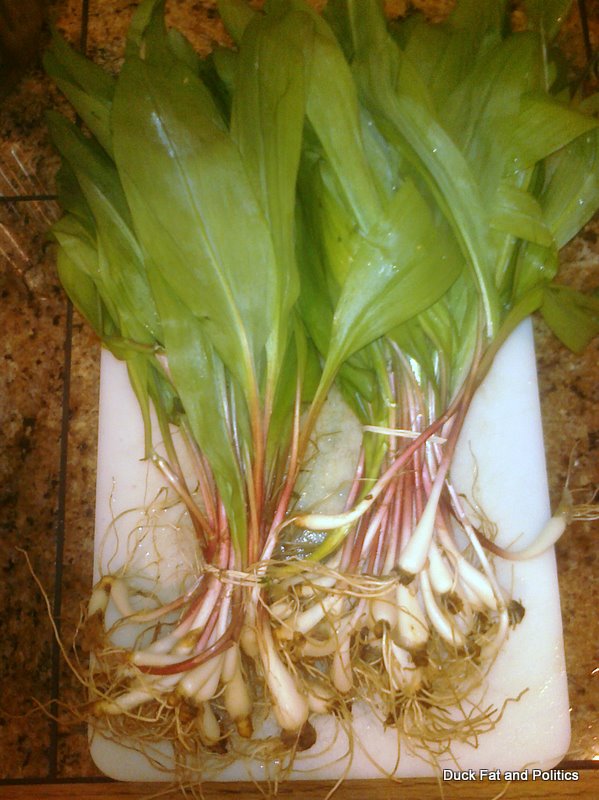
Ramps

Driving through eastern Tennessee yesterday afternoon I crossed the French Broad River, rounded a bend, and saw a pickup truck, a small table, and a large plastic sign with 'RAMPS' scrawled on it.  I pulled over and walked up to the little table, heaped with bunches of just-picked ramps, a southern harbinger of spring.
A man in his twenties got out of the truck and we started talking.  "Where did you pick them?" I asked, and he replied, "That's confidential," but when I told him I was just passing through he added, "I'll tell you that they were picked in Madison County," and wouldn't say anymore.  The day before he had picked over one hundred bunches and less than a dozen remained.  I asked the man his favorite way to prepare them and he said he ate them raw, almost every day. 
With their sweet leaves that remind me of toothsome garlic chives, ramps taste more like young garlic than leeks.  I kept them simple.  After removing their roots and cleaning them well, I put the bulbs in a frying pan with a generous nob of butter.   A few minutes later I added the green leaves, stirred them for a minute or so, and removed them from the heat.  A generous shake of salt and pepper and they were ready to eat. We gobbled them down with grilled tuna steaks and a pinot grigio to celebrate my sister's birthday, and ended the delightful meal with her just-made carrot cake - mmmmm! 

Southern swing

The meat and three is a southern institution that most resembles a cafeteria to a visitor from the far edge of the northern United States.  What sets it apart from a cafeteria, though, is its food - real southern food cooked day in and day out for so many years that over time each dish is perfected the way a canoe or dog sled or wind mill achieves a perfection of design: there's no more to pare away; all that remains is its heart and soul, beating, alive.
Arnold's in Nashville, Tennessee is just such a place, with long lunch lines and tables that are cleared as quickly as the chess pie is refreshed in the serving line.  Okra cooked the way my mom cooked ratatouille, with olive oil and oregano.  Greens scooped from a huge pan, just enough vinegar to add sparkle to the chew; hush puppies bigger than golf balls, brown and crisp with an almost sweet, tender interior; black eyed peas that speak of the earth; catfish as tender as the crust is crisp; and pie, real pie that nourishes us, reminds us that food ties us together, nourishes body and community and brings together people from all walk of life to say "Yes."  Goodness, the chess pie - a simple custard pie rich in eggs, butter, and sugar, baked in a lard crust and served to make everyone who eats it heave a sigh of joy, contentment, pride and satisfaction that our regional cooking rises still, nourishing natives and visitors alike.

20 April 2010

Rabbit sausage

Saturday was enjoyed in the backyard, building a new chicken coop.  I wanted to keep working until dark, so I paused only briefly to fire up our first grill of the year.  The Weber Smokey Joe is the perfect size for family meals, and my wife grilled rabbit sausage over lump hardwood charcoal.  Cooked over low heat, we removed the lid for the last few minutes to brown the links.  Seasoned with thyme and accompanied by a cold Summit Pale Ale, the sausage was a great start to grilling season. 

15 April 2010

Lahp and sticky rice - the beginning of a Northeastern Thai meal

If you want to dive into authentic Thai cuisine, here’s a great dish to begin with.  This is the beginning of a rural meal with roots in the poor, northeastern part of the country known as Issan.  Lahp was originally made with intestines and other bits of offal, and the heavy seasoning gave flavor to the only bits of meat the very poor could afford. Nowadays, it’s made with a range of meats – pork, duck, and chicken – but pork remains the most common. This highly seasoned dish is served with sticky rice and slices of cool cucumber and fresh basil leaves on the side.

Special equipment: stone mortar and pestle for the lahp and a clay mortar and pestle for the somtom (recipe coming in a later post.) Here’s a reason to buy two pieces of kitchen gear, one of which (the stone one) is absolutely indispensible for cooking Thai food. A stone mortar and pestle is used in this dish for crushing uncooked, dry-fried sticky rice rice into a fine powder. No other piece of equipment will adequately pulverize the rice. But, if you don’t have one, continue on with this recipe – a bean/spice grinder will do the job well enough for your initial forays into making lahp! But over time, a granite mortar and pestle is invaluable if you cook Thai food.

Ingredients
¾ - 1 pound pork. Let me suggest that you don’t buy ground pork unless necessary. Here’s why. If you buy an inexpensive piece of pork, say, pork shoulder, you can mince it the way Thais do, giving it a texture that’s not as uniform as meat that goes through a big grinder. Put the meat on a sturdy wood cutting block, and using a big knife, start chopping. You need a knife with a little heft, and one that has a mostly straight blade. Keep chopping using a rapid up-down motion, scraping the meat back together when it starts to spread out too far, turning it every so often to ensure you’re chopping it in different directions. The main thing to pay attention to is that strings of fat, sinew, or tissue don’t hold together, giving you a long string of partially chopped meat. After a few minutes it’ll begin to look minced, and when you’ve got a nice, fine mince, you’re done.

2 cups pahk chee farang ผักชีฝรั่ง, not well known in English but variously called culantro, sawtooth coriander or long leaf cilantro. Eryngium Foetidum. It’s a long, thin, green leaf, 6”- 8” long, perhaps as wide as a butter knife with a serrated edge. I can regularly find it fresh in Asian markets, and prefer it over mint, which can also be used. If you use the long leaf cilantro, chop it into pieces about ½”. Be generous with your measuring.

Roast 2 tbsp uncooked sticky rice in dry frying pan until it’s a pretty, golden brown. Roasting the uncooked rice gives it a deep, nutty taste, and it acts as a binder, as well, absorbing some of the the scant liquid that remains after the pork is cooked. I have a very small cast iron pan I use for this. Over medium heat I add the rice and gently shake the pan, keeping the rice in constant motion. Regular motion is especially important towards the end of the roasting time, when a little distraction can lead to burnt rice. Luckily, it’s only a few tablespoons and you can do it again! Dump into mortar and pestle (or spice grinder) and add 1 tsp salt. Pulverize in mortar and pestle until a fine powder. Be patient; it takes quite awhile. Set aside in small bowl.

Roast 20-30 dried Thai chili peppers in pan. (Those quantities are from the original recipe I first wrote in Thai. American tastes will probably think 6-10 chilies are adequate.) Using the same pan as the one used for the rice, dry roast the chilies until they’re charred; be careful, the smoky oil the cooking chilies can be an irritant. Crush in mortar, but keep chunky. There should be bits of skin from the peppers that are larger than what you’d find in a shake jar of “crushed chili peppers”. Set aside in small bowl.

Thinly slice 3-4 shallots. Set aside in small bowl.
Thinly slice 2-3 scallions. Set aside in small bowl.
Juice from 1 lime. Squeeze and set aside in small bowl.

Mince ¾ - 1 lb pork, chicken, duck or beef. In small sauce pan on stove, cook meat in a little water – maybe ½ to ¾ cup -- until cooked through. It should only take a few minutes. Take off stove.

Add lime juice and stir
Add fish sauce and stir
Taste. Correct balance of sour/salt, if necessary
Add crushed peppers – don’t add the whole amount at once if you’re not sure of your enjoyment of heat. Stir
Add crushed rice and mix in
Add shallots
Add scallions and stir
Add mint/ pahk chi farang and mix
Put in serving bowl
Sprinkle additional mint leaves on top

Eat with sticky rice and cold beer.

Shad roe

During the shad’s annual run up the James River, Richmond, Virginia residents have historically indulged in shad roe the way many of us celebrate the return of asparagus. One longtime resident told me she used to eat the roe sacs wrapped in wax paper seasoned only with a little butter. The shad population, indescribably dense in colonial times, has suffered the way most fish species have in our polluted, over-developed waterways, and smaller runs have been the norm for ages. Indeed, several people I asked in Richmond had no idea of the shad run, while one said, “I know someone who’ll know." One phone call uncovered a supplier of them and I quickly found a restaurant serving them.
 Edo’s Squid, a nice little restaurant off Broad Street in Richmond, posts its Italian-derived menu on just two sheets of paper hung on the exposed brick wall: choices today included skate wing, shad roe, quail, fried squid and several pasta dishes. The restaurant occupies the second floor of an old brick building and the lunchtime ambience was sunny and comfortable.
Shad roe are about the size of flying fish roe, perhaps a little bigger. The lobes are taken from the females and the two lobes weigh about three ounces apiece. The eggs are kept together in the sac, a thin membrane with several veins running along the bottom side of the sac. They’re usually served together as a main course or a single lobe for an appetizer.

Deep-fried bread, a lobe gently poached and sautéed, melted mozzarella cheese with a caper sauce on top, and a flourish a fresh, sweet and tart greens dancing on the other side of the plate, a green springiness to delight the shad’s return. The roe was cooked through, and I wonder if the quality of shad roe is high enough to eat raw; no one I spoke with had eaten it raw. The roe had a nutty, slightly salty taste, a pleasing texture up against the fried bread and mozzarella. The caper sauce was beautiful, and the capers themselves were the smallest I’ve seen – BB-sized, perhaps scaled to match the mass of eggs underneath my fork.

Earlier in the month I ate avgotaraho – cured and preserved roe from the grey mullet – a Greek specialty, and today I ate shad roe. I live in the Land of 10,000 Lakes, and I wonder if anyone eats the eggs of any of our local fish. Does anyone out there have any experience with the freshwater roe of our local fish? Are there any laws covering the harvesting of fish roe in Minnesota? Let me know if you have any experience with roe in Minnesota.

07 April 2010

Beekeeping

On this evening's radio broadcast of Duck Fat and Politics, I spoke with gardener and beekeeper Chris Sullivan-Kelley.  She told listeners about several helpful resources and I want to post them here for your convenience.
The University of Minnesota offers an annual short course on beekeeping.  Beekeeping must be experiencing a significant resurgence because the program's 250 person enrollment limit has a 140 person wait list; they're now offering a fall course as well.
Chris recommended Betterbee as a good online company for bees, books, and other beekeeping supplies.
If you live in Minnesota, check out the MN Hobby Beekeepers Association for more information.   Others can find local resources online. 
If you have any good beekeeping information, feel free to share it in the comments section. Thanks!

01 April 2010

Duck Fast

Stayed tuned for DUCK FAST, the quickest (and best) way to eat fast and look great.  After all the time I've spent rendering duck fat, I've noticed that my hands look great.  So, working with a small manufacturing laboratory, I've developed a hand cream that tastes as good as any mortar and pestle-made aioli.  DUCK FAST works in two ways: first, just rub it on any chicken, pork, or beef, and have instant duck-flavored meat.  And, while you're at it, lick your fingers any time you're feeling a little too hungry to wait until meal time.  You'll notice before long that you're eating smaller meals and looking younger! 
DUCK FAST is guaranteed to make all your food taste as though it was made in the south of France, and before you know it, all that finger-licking-good fat will wash away wrinkles, liver spots, decrepitude and mortality.

29 March 2010

Slow pork roast

Despite the hard work by pork producers to market "the other white meat," little has been done to keep people from cooking it to death.
I started my pork shoulder roast on Tuesday night, rubbing generous amounts of salt, thyme, garlic, pepper and rosemary into the flesh.  I wrapped it tightly and put it in the back of the icebox until Saturday afternoon.   A big roast, about 7 1/2 pounds, with a bone in it.  I let it move towards room temperature for a few hours before I put it into a 400 F oven, surrounded by big chunks of russet potatoes.  A few scoops of duck fat kept everything honest and well lubricated. 
I had to remove the potatoes from the roasting pan after about an hour because they were browning quickly and the roast still had awhile to go.  I cooked the roast until its internal temperature was just under 140 F, and removed it from the oven and covered it with foil; I used the resting time to finish the potatoes in a 9x13 pan, scooping a little of the fat to refresh the potatoes.
By the time we finished our salad, the thermometer in the roast almost read 160 F.  I cut a few slices and the meat was juicier than a greasy hamburger and still had a nice pink hue to it.  I served it with applesauce and a raisin-onion chutney.  The potatoes were crisp on the outside and baked-potato fluffy on the inside.
We drank a stunning 2005 Alsace Grand Cru Mambourg Gewurztraminer and the massive floral nose nearly knocked me over.  Simply swirling the glass made the dining room vernal.  The intensity of the Gewurztraminer bouquet is unmatched, I think, by any other wine. I don't swoon very often, but every time I raised the glass I first pulled it to my nose and inhaled the memory of springtime love, wet plum blossoms splashed against dark bark, old Chinese poets remembering their youth.  And with it, a still-pink, still-juicy pork roast with pork-and-duck-fat roasted potatoes.

14 March 2010

Confit of rabbit leg


I was going to roast a pork shoulder for dinner tonight but my wife and daughters went to see Mamma Mia, making a roast impractical, so I decided to break through the fat protecting my recently made rabbit confit and taste the early results.  After a day outside in the early spring sunshine, not turning on the oven was fine with me. 
Every batch of confit is different, and the changes I made while using rabbit for the first time worked well.  Encasing the legs in a sheath of pig skin, and keeping the oven under 200F for the long, slow cooking really preserved the flavor and lightness of the meat.
Unlike duck or goose legs, rabbits don't have any protective skin that wants crisping, so after I extracted the first two legs that broke free from fat, a brief sizzle in the pan was all that was needed.  Good mashed potatoes, and firm brussels sprouts rounded out the plate. 
I had a glass of a Kante 2005 Malvasia from Italy's Carso DOC, a beautiful dry, minerally white wine. The rabbit legs were given a rub of thyme and juniper berry before they were confited, and the lack of fruitiness in the wine let those seasonings continue, in their now-muted role, to linger.

11 March 2010

Rabbit: confit, sausage, meatballs, stock

This week I cut up two rabbits and made numerous things with them.  I was surprised at the 8 oz. hind legs, and as soon as I appreciated their size I thought of confit.  I hadn't made rabbit confit before, but the legs had the same feel as the numerous duck legs I've slipped into pots of fat. Some of my rabbit stews this winter haven't gone over well with the family, so I decided to treat the rabbits the same way I do ducks - differently.  I always cut up ducks and use the various parts separately; roasting a whole duck seems like a perfectly good way to ruin half a duck, so I keep away from that time-honored method.  
When I make pancetta I'm usually left with a big piece of pig skin which I throw in the freezer; I first thought of wrapping the long, lean loins in the pig skin and roasting them, but decided to use  the pig skin as a blanket, insulator, and moisturizer for the poaching-in-fat, slow-cooking rabbit leg confit.  After marinating the rabbit meat with a rub that contained juniper berries, thyme, garlic, salt and bay leaves, I unfolded a long piece of pig skin and put it on the bottom of the dutch oven.  The rabbit pieces went on top of that, after which I covered any exposed rabbit with another big piece of pig skin.  I melted a pan of duck fat and covered the whole thing, and put it into a slow, 200F oven. 
I made sausage with the loins and miscellaneous bits of meat, adding a little pork and back fat to the mixture.  The sausage meat also marinated overnight, and the three pounds of links will probably be grilled.  My meat grinder has a space in the front that, when I'm done grinding or stuffing, still holds nearly a pound of meat.  I made meatballs with that loose meat, adding breadcrumbs, eggs, shallots and a little more seasoning before forming small meatballs that I poached in a reduced rabbit stock, made from the stripped-bare carcasses and enhanced with onions, celery, etc...
My kids and I enjoyed a simple plate of pasta, peas and rabbit meatballs this evening, and we all look forward to our upcoming meals with this versatile animal. 


01 March 2010

Just Food's Winter Eat Local Challenge

Northfield's Just Foods Co-op is again sponsoring a week-long eat local food challenge.  I'm again joining with a group of Northfield bloggers during the Winter Eat Local Challenge to write about it.  It's fun to think about local food in Minnesota during the winter!  I hope you visit their website and get some good ideas for your own kitchen.  Here's a post I just wrote for the challenge:
Blueberries and planning