25 April 2010

Rabbit cacciatore

My son has the best nose in the family.  I was starting a cacciatore, rich with oil, garlic, and minced carrots and celery, when I added a wedge of Taza stone ground chocolate; Henry called from the family room, "I smell chocolate."  A dark piece to deepen the stew-sauce, red wine next, all bubbling thick and fragrancy, sweet, too.  That old rabbit confit next, pieces still emerging from fat all tender and moist, breaking into chunks just right for a drizzle-grey spring dinner, candelit and tableclothed, clothes still carrying sawdust and paint from afternoon projects.
My daughter stirred the sauce, breaking each tomato in the hot pan, keeping it thick.  For seasoning we added just a bit of fennel to the wine and chocolate, a last minute decision as my daughter smelled and rejected other herbs and spices.  A quick sauce ladled over spaghetti, a beautiful balance of tastes.
The last time I opened an Ioppa 2001 Ghemme I wasn't impressed; tonight's was different, and the nebbiolo-dominated wine opened with cherries and violets, soft with leather-like tannins, graceful and still fresh.  Cacciatore is known as hunter's stew, and the rabbit confit tasted better than most other meats would in the chocolate-and-wine-laced sauce, edible proof that raising rabbits in town is worth the effort.

22 April 2010

Ramps

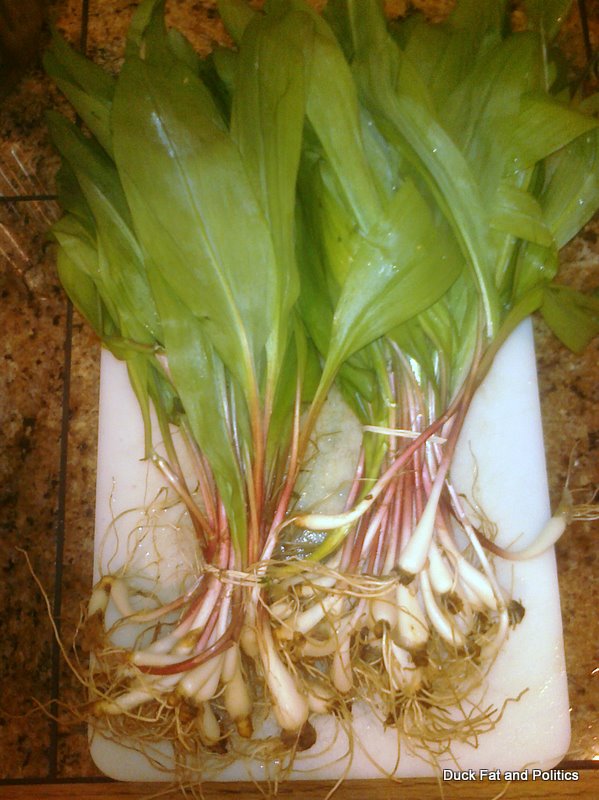
Driving through eastern Tennessee yesterday afternoon I crossed the French Broad River, rounded a bend, and saw a pickup truck, a small table, and a large plastic sign with 'RAMPS' scrawled on it.  I pulled over and walked up to the little table, heaped with bunches of just-picked ramps, a southern harbinger of spring.
A man in his twenties got out of the truck and we started talking.  "Where did you pick them?" I asked, and he replied, "That's confidential," but when I told him I was just passing through he added, "I'll tell you that they were picked in Madison County," and wouldn't say anymore.  The day before he had picked over one hundred bunches and less than a dozen remained.  I asked the man his favorite way to prepare them and he said he ate them raw, almost every day. 
With their sweet leaves that remind me of toothsome garlic chives, ramps taste more like young garlic than leeks.  I kept them simple.  After removing their roots and cleaning them well, I put the bulbs in a frying pan with a generous nob of butter.   A few minutes later I added the green leaves, stirred them for a minute or so, and removed them from the heat.  A generous shake of salt and pepper and they were ready to eat. We gobbled them down with grilled tuna steaks and a pinot grigio to celebrate my sister's birthday, and ended the delightful meal with her just-made carrot cake - mmmmm! 

Southern swing

The meat and three is a southern institution that most resembles a cafeteria to a visitor from the far edge of the northern United States.  What sets it apart from a cafeteria, though, is its food - real southern food cooked day in and day out for so many years that over time each dish is perfected the way a canoe or dog sled or wind mill achieves a perfection of design: there's no more to pare away; all that remains is its heart and soul, beating, alive.
Arnold's in Nashville, Tennessee is just such a place, with long lunch lines and tables that are cleared as quickly as the chess pie is refreshed in the serving line.  Okra cooked the way my mom cooked ratatouille, with olive oil and oregano.  Greens scooped from a huge pan, just enough vinegar to add sparkle to the chew; hush puppies bigger than golf balls, brown and crisp with an almost sweet, tender interior; black eyed peas that speak of the earth; catfish as tender as the crust is crisp; and pie, real pie that nourishes us, reminds us that food ties us together, nourishes body and community and brings together people from all walk of life to say "Yes."  Goodness, the chess pie - a simple custard pie rich in eggs, butter, and sugar, baked in a lard crust and served to make everyone who eats it heave a sigh of joy, contentment, pride and satisfaction that our regional cooking rises still, nourishing natives and visitors alike.

20 April 2010

Rabbit sausage

Saturday was enjoyed in the backyard, building a new chicken coop.  I wanted to keep working until dark, so I paused only briefly to fire up our first grill of the year.  The Weber Smokey Joe is the perfect size for family meals, and my wife grilled rabbit sausage over lump hardwood charcoal.  Cooked over low heat, we removed the lid for the last few minutes to brown the links.  Seasoned with thyme and accompanied by a cold Summit Pale Ale, the sausage was a great start to grilling season. 

15 April 2010

Lahp and sticky rice - the beginning of a Northeastern Thai meal

If you want to dive into authentic Thai cuisine, here’s a great dish to begin with.  This is the beginning of a rural meal with roots in the poor, northeastern part of the country known as Issan.  Lahp was originally made with intestines and other bits of offal, and the heavy seasoning gave flavor to the only bits of meat the very poor could afford. Nowadays, it’s made with a range of meats – pork, duck, and chicken – but pork remains the most common. This highly seasoned dish is served with sticky rice and slices of cool cucumber and fresh basil leaves on the side.

Special equipment: stone mortar and pestle for the lahp and a clay mortar and pestle for the somtom (recipe coming in a later post.) Here’s a reason to buy two pieces of kitchen gear, one of which (the stone one) is absolutely indispensible for cooking Thai food. A stone mortar and pestle is used in this dish for crushing uncooked, dry-fried sticky rice rice into a fine powder. No other piece of equipment will adequately pulverize the rice. But, if you don’t have one, continue on with this recipe – a bean/spice grinder will do the job well enough for your initial forays into making lahp! But over time, a granite mortar and pestle is invaluable if you cook Thai food.

Ingredients
¾ - 1 pound pork. Let me suggest that you don’t buy ground pork unless necessary. Here’s why. If you buy an inexpensive piece of pork, say, pork shoulder, you can mince it the way Thais do, giving it a texture that’s not as uniform as meat that goes through a big grinder. Put the meat on a sturdy wood cutting block, and using a big knife, start chopping. You need a knife with a little heft, and one that has a mostly straight blade. Keep chopping using a rapid up-down motion, scraping the meat back together when it starts to spread out too far, turning it every so often to ensure you’re chopping it in different directions. The main thing to pay attention to is that strings of fat, sinew, or tissue don’t hold together, giving you a long string of partially chopped meat. After a few minutes it’ll begin to look minced, and when you’ve got a nice, fine mince, you’re done.

2 cups pahk chee farang ผักชีฝรั่ง, not well known in English but variously called culantro, sawtooth coriander or long leaf cilantro. Eryngium Foetidum. It’s a long, thin, green leaf, 6”- 8” long, perhaps as wide as a butter knife with a serrated edge. I can regularly find it fresh in Asian markets, and prefer it over mint, which can also be used. If you use the long leaf cilantro, chop it into pieces about ½”. Be generous with your measuring.

Roast 2 tbsp uncooked sticky rice in dry frying pan until it’s a pretty, golden brown. Roasting the uncooked rice gives it a deep, nutty taste, and it acts as a binder, as well, absorbing some of the the scant liquid that remains after the pork is cooked. I have a very small cast iron pan I use for this. Over medium heat I add the rice and gently shake the pan, keeping the rice in constant motion. Regular motion is especially important towards the end of the roasting time, when a little distraction can lead to burnt rice. Luckily, it’s only a few tablespoons and you can do it again! Dump into mortar and pestle (or spice grinder) and add 1 tsp salt. Pulverize in mortar and pestle until a fine powder. Be patient; it takes quite awhile. Set aside in small bowl.

Roast 20-30 dried Thai chili peppers in pan. (Those quantities are from the original recipe I first wrote in Thai. American tastes will probably think 6-10 chilies are adequate.) Using the same pan as the one used for the rice, dry roast the chilies until they’re charred; be careful, the smoky oil the cooking chilies can be an irritant. Crush in mortar, but keep chunky. There should be bits of skin from the peppers that are larger than what you’d find in a shake jar of “crushed chili peppers”. Set aside in small bowl.

Thinly slice 3-4 shallots. Set aside in small bowl.
Thinly slice 2-3 scallions. Set aside in small bowl.
Juice from 1 lime. Squeeze and set aside in small bowl.

Mince ¾ - 1 lb pork, chicken, duck or beef. In small sauce pan on stove, cook meat in a little water – maybe ½ to ¾ cup -- until cooked through. It should only take a few minutes. Take off stove.

Add lime juice and stir
Add fish sauce and stir
Taste. Correct balance of sour/salt, if necessary
Add crushed peppers – don’t add the whole amount at once if you’re not sure of your enjoyment of heat. Stir
Add crushed rice and mix in
Add shallots
Add scallions and stir
Add mint/ pahk chi farang and mix
Put in serving bowl
Sprinkle additional mint leaves on top

Eat with sticky rice and cold beer.

Shad roe

During the shad’s annual run up the James River, Richmond, Virginia residents have historically indulged in shad roe the way many of us celebrate the return of asparagus. One longtime resident told me she used to eat the roe sacs wrapped in wax paper seasoned only with a little butter. The shad population, indescribably dense in colonial times, has suffered the way most fish species have in our polluted, over-developed waterways, and smaller runs have been the norm for ages. Indeed, several people I asked in Richmond had no idea of the shad run, while one said, “I know someone who’ll know." One phone call uncovered a supplier of them and I quickly found a restaurant serving them.
 Edo’s Squid, a nice little restaurant off Broad Street in Richmond, posts its Italian-derived menu on just two sheets of paper hung on the exposed brick wall: choices today included skate wing, shad roe, quail, fried squid and several pasta dishes. The restaurant occupies the second floor of an old brick building and the lunchtime ambience was sunny and comfortable.
Shad roe are about the size of flying fish roe, perhaps a little bigger. The lobes are taken from the females and the two lobes weigh about three ounces apiece. The eggs are kept together in the sac, a thin membrane with several veins running along the bottom side of the sac. They’re usually served together as a main course or a single lobe for an appetizer.

Deep-fried bread, a lobe gently poached and sautéed, melted mozzarella cheese with a caper sauce on top, and a flourish a fresh, sweet and tart greens dancing on the other side of the plate, a green springiness to delight the shad’s return. The roe was cooked through, and I wonder if the quality of shad roe is high enough to eat raw; no one I spoke with had eaten it raw. The roe had a nutty, slightly salty taste, a pleasing texture up against the fried bread and mozzarella. The caper sauce was beautiful, and the capers themselves were the smallest I’ve seen – BB-sized, perhaps scaled to match the mass of eggs underneath my fork.

Earlier in the month I ate avgotaraho – cured and preserved roe from the grey mullet – a Greek specialty, and today I ate shad roe. I live in the Land of 10,000 Lakes, and I wonder if anyone eats the eggs of any of our local fish. Does anyone out there have any experience with the freshwater roe of our local fish? Are there any laws covering the harvesting of fish roe in Minnesota? Let me know if you have any experience with roe in Minnesota.

07 April 2010

Beekeeping

On this evening's radio broadcast of Duck Fat and Politics, I spoke with gardener and beekeeper Chris Sullivan-Kelley.  She told listeners about several helpful resources and I want to post them here for your convenience.
The University of Minnesota offers an annual short course on beekeeping.  Beekeeping must be experiencing a significant resurgence because the program's 250 person enrollment limit has a 140 person wait list; they're now offering a fall course as well.
Chris recommended Betterbee as a good online company for bees, books, and other beekeeping supplies.
If you live in Minnesota, check out the MN Hobby Beekeepers Association for more information.   Others can find local resources online. 
If you have any good beekeeping information, feel free to share it in the comments section. Thanks!

01 April 2010

Duck Fast

Stayed tuned for DUCK FAST, the quickest (and best) way to eat fast and look great.  After all the time I've spent rendering duck fat, I've noticed that my hands look great.  So, working with a small manufacturing laboratory, I've developed a hand cream that tastes as good as any mortar and pestle-made aioli.  DUCK FAST works in two ways: first, just rub it on any chicken, pork, or beef, and have instant duck-flavored meat.  And, while you're at it, lick your fingers any time you're feeling a little too hungry to wait until meal time.  You'll notice before long that you're eating smaller meals and looking younger! 
DUCK FAST is guaranteed to make all your food taste as though it was made in the south of France, and before you know it, all that finger-licking-good fat will wash away wrinkles, liver spots, decrepitude and mortality.

29 March 2010

Slow pork roast

Despite the hard work by pork producers to market "the other white meat," little has been done to keep people from cooking it to death.
I started my pork shoulder roast on Tuesday night, rubbing generous amounts of salt, thyme, garlic, pepper and rosemary into the flesh.  I wrapped it tightly and put it in the back of the icebox until Saturday afternoon.   A big roast, about 7 1/2 pounds, with a bone in it.  I let it move towards room temperature for a few hours before I put it into a 400 F oven, surrounded by big chunks of russet potatoes.  A few scoops of duck fat kept everything honest and well lubricated. 
I had to remove the potatoes from the roasting pan after about an hour because they were browning quickly and the roast still had awhile to go.  I cooked the roast until its internal temperature was just under 140 F, and removed it from the oven and covered it with foil; I used the resting time to finish the potatoes in a 9x13 pan, scooping a little of the fat to refresh the potatoes.
By the time we finished our salad, the thermometer in the roast almost read 160 F.  I cut a few slices and the meat was juicier than a greasy hamburger and still had a nice pink hue to it.  I served it with applesauce and a raisin-onion chutney.  The potatoes were crisp on the outside and baked-potato fluffy on the inside.
We drank a stunning 2005 Alsace Grand Cru Mambourg Gewurztraminer and the massive floral nose nearly knocked me over.  Simply swirling the glass made the dining room vernal.  The intensity of the Gewurztraminer bouquet is unmatched, I think, by any other wine. I don't swoon very often, but every time I raised the glass I first pulled it to my nose and inhaled the memory of springtime love, wet plum blossoms splashed against dark bark, old Chinese poets remembering their youth.  And with it, a still-pink, still-juicy pork roast with pork-and-duck-fat roasted potatoes.

14 March 2010

Confit of rabbit leg


I was going to roast a pork shoulder for dinner tonight but my wife and daughters went to see Mamma Mia, making a roast impractical, so I decided to break through the fat protecting my recently made rabbit confit and taste the early results.  After a day outside in the early spring sunshine, not turning on the oven was fine with me. 
Every batch of confit is different, and the changes I made while using rabbit for the first time worked well.  Encasing the legs in a sheath of pig skin, and keeping the oven under 200F for the long, slow cooking really preserved the flavor and lightness of the meat.
Unlike duck or goose legs, rabbits don't have any protective skin that wants crisping, so after I extracted the first two legs that broke free from fat, a brief sizzle in the pan was all that was needed.  Good mashed potatoes, and firm brussels sprouts rounded out the plate. 
I had a glass of a Kante 2005 Malvasia from Italy's Carso DOC, a beautiful dry, minerally white wine. The rabbit legs were given a rub of thyme and juniper berry before they were confited, and the lack of fruitiness in the wine let those seasonings continue, in their now-muted role, to linger.

11 March 2010

Rabbit: confit, sausage, meatballs, stock

This week I cut up two rabbits and made numerous things with them.  I was surprised at the 8 oz. hind legs, and as soon as I appreciated their size I thought of confit.  I hadn't made rabbit confit before, but the legs had the same feel as the numerous duck legs I've slipped into pots of fat. Some of my rabbit stews this winter haven't gone over well with the family, so I decided to treat the rabbits the same way I do ducks - differently.  I always cut up ducks and use the various parts separately; roasting a whole duck seems like a perfectly good way to ruin half a duck, so I keep away from that time-honored method.  
When I make pancetta I'm usually left with a big piece of pig skin which I throw in the freezer; I first thought of wrapping the long, lean loins in the pig skin and roasting them, but decided to use  the pig skin as a blanket, insulator, and moisturizer for the poaching-in-fat, slow-cooking rabbit leg confit.  After marinating the rabbit meat with a rub that contained juniper berries, thyme, garlic, salt and bay leaves, I unfolded a long piece of pig skin and put it on the bottom of the dutch oven.  The rabbit pieces went on top of that, after which I covered any exposed rabbit with another big piece of pig skin.  I melted a pan of duck fat and covered the whole thing, and put it into a slow, 200F oven. 
I made sausage with the loins and miscellaneous bits of meat, adding a little pork and back fat to the mixture.  The sausage meat also marinated overnight, and the three pounds of links will probably be grilled.  My meat grinder has a space in the front that, when I'm done grinding or stuffing, still holds nearly a pound of meat.  I made meatballs with that loose meat, adding breadcrumbs, eggs, shallots and a little more seasoning before forming small meatballs that I poached in a reduced rabbit stock, made from the stripped-bare carcasses and enhanced with onions, celery, etc...
My kids and I enjoyed a simple plate of pasta, peas and rabbit meatballs this evening, and we all look forward to our upcoming meals with this versatile animal. 


01 March 2010

Just Food's Winter Eat Local Challenge

Northfield's Just Foods Co-op is again sponsoring a week-long eat local food challenge.  I'm again joining with a group of Northfield bloggers during the Winter Eat Local Challenge to write about it.  It's fun to think about local food in Minnesota during the winter!  I hope you visit their website and get some good ideas for your own kitchen.  Here's a post I just wrote for the challenge:
Blueberries and planning

28 February 2010

Wide pasta with fresh tomato sauce


Tonight's pasta left me wanting more.  As I was making the dough I added another egg because it felt too stiff and dry, but adding an egg made a sticky mess of the whole thing and it took ten minutes to really incorporate it into the mass of already-formed dough.  There is nothing like the feel of well-kneaded pasta dough; it's softer than silk, pliable, fragrant, and almost cool to the touch.
I made sauce while the dough rested.  A carrot, two stalks of celery, an onion, and half a yellow pepper in a big glug of olive oil.  Salt, pepper, and a more-than-generous three-finger pinch of marjoram.  For the past six months I've been using lots of marjoram; it adds a sweet, floral brightness that I can't seem to get enough of. Then a large ziploc bag of plain, frozen tomatoes, quickly cooked last fall to make it easier to put them into gallon-sized freezer bags.  We lay them flat and stack them on the freezer shelves.  Uffda, they were acidic, though, so I added a tablespoon of sugar and let everything simmer for a half hour or so. 
My pasta machine's rollers go from 7 - the widest setting, to 1 - the narrowest, and the narrower the opening the thinner the pasta.  I usually roll my pasta dough to a 2 or 3, making it thin but still with some body and heft.  The dough was rolling out nice, and some of the pieces were extremely long, so long I had to cut them into thirds to fit on the table. I decided to hand cut the noodles tonight, and it's easy if a little flour is sprinkled on the sheets of dry-to-the-touch-but still-pliable dough.  I rolled it up and cut it into 1/2 - 1 inch widths - I wanted a big, wide pasta this evening.
I've been having a little trouble lately with fresh pasta cooling and clumping up after it's cooked, so I decided to take the pasta right from the water and mix it immediately with the sauce.  It cooked quickly - two minutes or so, and I used a pasta scoop to retrieve the long, wide noodles.  With water still streaming off the noodles, I transferred them to the sauce pan, and then stirred them gently to coat them in sauce.  From there the pasta went into oven-warmed bowls, and into the dining room.
What was it that made it so good tonight?   The yellow pepper added sweetness to the sauce, and the summer tomatoes were bursting with flavor.  The bite of fresh pasta can't be beat, especially when it's coated with just-cooked memories of last summer.  Spring doesn't seem all that far off now.

25 February 2010

Duck Fat Frittata


I started this frittata with a few tablespoons of duck fat in the enameled cast-iron frying pan. A low flame softened the fat slowly, and as it melted it turned clear and pooled on the bottom of the pan. A sliced onion came first, followed by four or five small potatoes, also thinly sliced. I let them soften in the low heat while I fished a few rabbit hearts and kidneys from the bowl of many-times-used-for-confit duck fat, memories of poaching them in the fat many months ago a fading memory. I sliced the meat pieces and scattered them around the frying pan, letting the clinging fat melt into the whole. A generous sprinkle of tarragon followed by a little thyme, and then I shook a heavy dose of black pepper over the whole thing.

I broke five fresh eggs into a bowl and beat them with a fork, and then tasted the onion-potato mixture to see if any additional salt was needed. Turning the heat down very low, I poured the eggs into the pan and grated parmesan cheese over the whole thing. My eight-year old daughter and I read a reader’s theater version of Ronia, the Robber’s Daughter for twenty minutes or so while the frittata cooked, and when the whole thing was firm except for an egg-y liquid that moved just underneath a now-forming crust, I put it under the broiler for a minute or two. I let it rest briefly, but my daughter and I were hungry and no one else was home, so we each ate a pie-shaped piece of frittata along with a big salad. We speared lettuce on the tines of our forks, and had a contest to see how much lettuce we could retrieve with a single poke into the salad bowl. The frittata was delicious, but we remembered the Spanish omelette we ate at the beginning of winter at a friend’s house, on a baguette, and wished we had one. And for dessert, a bowl of applesauce with a deep dusting of Vietnamese cinnamon on top.

Pannukakku


My friend and neighbor Doug shared this wonderful Pannukakku recipe because he, too, raises chickens and has an abundance of eggs; our family is quickly adopting his family's tradition of eating it weekly! Pannukakku is, besides being a wonderful word, a Finnish pancake that is more popover than pancake. The simple batter rests for a half hour before being baked, and the pan is coated with ½ stick butter. What I like so much about it is that it tastes so buttery; I think it’s because no butter is added to the batter, and the butter in the pan eventually pools on the top of the pannukakku, bubbling right on the surface and making it taste more buttery than it actually is. We still have many pounds of blueberries in the freezer, so lightly whipped cream is a great accompaniment to blueberries heated in a pan for a few minutes – it takes the chill out of them. A few years ago we went through a “Waffle Friday” faze, eating a wide assortment of waffles and toppings for Friday night dinner, so it’s nice to circle back with a new variant. I’ve seen pictures where the edges of pannukakku rise dramatically, like the wings of a spotted eagle ray gliding through the Caribbean.

Ingredients:
1-1/2 C flour (I use 1/2 C whole wheat)
1-1/2 C milk
6 eggs
1 T sugar
1 t salt
1/4 C butter for the baking pan

heavy cream for whipping

Directions:
In a bowl, whisk together first 5 ingredients until no lumps remain. Let stand 30 minutes. Preheat over to 450. Melt butter in a 9x13 pan by placing it in the preheating oven. (Remove pan when butter is melted to avoid scorching.) Brush entire pan with melted butter before pouring in the pancake batter. Bake 15 to 20 minutes, until edges are puffed high and golden. Top with whipped cream and fresh fruit (or thawed frozen blueberries.) Can also be served with a squeeze of lemon and powdered sugar. Serves 4 - 6.

19 February 2010

1981 Chateau Haut Brion


Three friends, sitting around a table with a beautiful bottle of wine.  Dan, our host and generous provider of this 1st Growth Bordeaux, was a boy when the grapes in this bottle were growing.  I took my first trip to Ireland and France in 1981; I washed dishes for months in a Greek diner in Buffalo to pay for it.  I was in Ireland for about four months before my already-meager savings were gone, so I took a ferry to France and ended up near Carcassonne, picking tomatoes with Moroccans and eating my first brain tagine.
So here we were, decades later, marveling at the time that had passed since the wine was bottled.  We were encouraged by the very small ullage, and excited when we removed the capsule and saw a cork in great condition.
From the first pour, this wine unfolded with strength, suppleness, and incredible elegance. Mature Bordeaux is such a joy to drink!  Pencil shavings and moist tobacco, followed by deep green peppers and lavender.  Joel pulled out its peaty earthiness, and we continually inhaled the ripe aromas of an old forest floor.  We played with words and were repaid with a finish so long I could taste it when I went to work the next morning.  Really.  It is so enjoyable to give a great wine its due.
I think a wine like this is a contemplative balm; there isn't a barrage of berries or fruit to pull us into a talky streak; no, this wine sang to our northern, winter brains.  As we drank the wine, each of us using all of our senses, our memories, our feelings, to embrace this wine and understand it, it was clear that whether someone's tasting notes contained "leather" or not was irrelevant.  We can use all our words to name something but we won't be able to taste it unless (or until) we let the wine speak for itself.  A wine like this really has its own personality, and it's completely different than a young wine, so much so that if we were looking for something familiar we'd miss the powerful, nuanced depth of the bottle.  It's funny how we kept coming back to anthropomorphic descriptors to understand the wine, maybe because we've all known people much older than ourselves who puzzle, delight, mystify, and inspire us - all at the same time. 
We couldn't hope for a better bottle of wine.  The centuries of craftsmanship and vinicultural stewardship that have made Haut Brion a great estate were in abundance in this bottle, and all three of us were grateful for the opportunity to drink this wine, plucked from the procession of time.

15 February 2010

Fasting

It's easy to think about food when we have so much of it.  It’s easy to indulge our interests when we’re encouraged to do so.  Food is, after all, central to our existence.  Although we’re emotionally removed from the burden of finding our food, we still spend huge amounts of our time surviving.  But we never think of it that way.  It’s just stopping at the coffee shop before work, having a doughnut with co-workers, bringing leftovers to work, thinking about lunch, eating and digesting it, wondering what to have for a snack, talking about dinner plans, stopping at the grocery store for milk and fruit, shopping, canning, freezing, gardening, and everything else that makes up a significant amount of our day, yet we never think of food as a survival issue.  Just like how we drive 75 miles an hour on the highway and never think about crashing until we see one, and we instinctively slow down: we’re hurtling along in a box of steel and plastic and it’s dangerous!  And food is still needed for survival, even when we dress it up in a restaurant and pay insane prices for a bellyful of nutrition.  So even though we don’t think about it in terms of survival, we’re still fulfilling that function every time we eat.  We’re mammals wandering the face of the earth, hoping not to starve, willing to do almost anything to survive.

And because our immediate survival isn’t usually on our minds when we eat our meat-and-three, it’s not surprising that the tradition of fasting has been abandoned by most Americans.  While it still plays a mostly-symbolic role for a few Americans, fasting is still actively practiced in other parts of the world and by adherents to many faiths.  But why fast?  Why go without food and cause discomfort?  What’s the point of it?  Did fasting arise out of necessity?  Why have people across time and continents willingly denied themselves food?  One could probably stand a short distance from fasting and judge it as an unnecessary and perhaps bizarre ritual.  From my perspective it seems like fasting is still relevant to people, but the farther we go from a sense of kinship – whether literal or spiritual – with poverty, the more remote the idea of fasting seems.  Fasting might seem like an extreme sacrifice to well (or over)-fed people, but a more common exercise or discipline for the spiritually-minded and those for whom hunger isn’t a distant memory. 

By fasting we recognize the primal role that food plays in our lives, that our attention to nourishing or simply filling our bodies is so dominant that we are aware of it only when we temporarily reject it.  And when we do that we can ask what other questions need to be answered.  Maybe fasting makes us more empathetic, more in sympathy with those who suffer the oppression of real hunger.  Fasting can humble us, too, because we quickly feel that very little separates the rich from the poor, the successful from the downtrodden, when the pangs of hunger begin to gnaw.  Fasting can give us strength, too, because we learn that our will, our spirit, our perseverance, can overcome limitations of the body.  Food keeps us from starving, but I think of fasting as something more than mock-hunger.  Are we, as living beings, our bodies alone?  Or is there a part of us that hunger cannot starve, which is nourished in emptiness?

Hunger is something completely different, and its devastating impact is felt by more than 1 billion people worldwide.  That number is so big it’s difficult to comprehend.  How can that many people be hungry?  And what can individuals do about it?  It’s a global issue that is affected by the highest levels of politics, bureaucracy, climate, war, and distribution.  Should we support any of the innumerable organizations that combat hunger, or urge our legislators to address hunger at a macro level?  When we support our local food shelf are we ignoring the larger problems of poverty and public health?  The ubiquity of fast food in the United States is directly related to our obesity epidemic, but it’s harder to sort through all the processed, prepared, and packaged food that sits on every grocery store shelf.  From packaged lasagna to sweetened snack bars, the gap between food that we eat directly from the earth and that which goes through significant processing continues to grow.  We are overrun by Kraft, Pepsico, and all the intermediaries who change our food.  How are we to understand global hunger when we’re overfed and preserved by endless food additives?

With so many hungry people in this world, and with so much food wasted in the United States, should Americans make an effort to better understand hunger?  Should we fast, not only for spiritual reasons, but to better know what hunger feels like?  Maybe if we experience hunger we’ll begin to get an inkling of its corrosive effect on societies around the world.  How many desperate acts begin with hunger?  And how much indifference is exhibited by us with the full stomachs?

07 February 2010

Big ravioli


A cold winter day and with fresh eggs in the fridge I thought about ravioli again.
I chopped up and sauteed spinach, added a fair amount of fresh ginger and green onions, and cooked it a little longer.  I broke up a hunk of blue cheese and almost a cup of ricotta.  An egg, salt and pepper, and the filling was ready to go.
As I rolled the dough out, lengthening and flattening it, I wanted to try something different.  So, instead of putting little teaspoons of filling onto the dough, I decided to make a few large ones, too - huge ones, in fact.  I made a sheet of regular, 2" squares, and then went large.  5"x6" or so, and when I cooked them, one at a time, the edges of the pasta waved like a sting ray gliding through water.  The large squarish shapes held together beautifully when cooking, and I used a slotted spoon to retrieve them.  I swished them around in a little butter and served them whole; we folded them over like crepes and seconds couldn't come quick enough.

26 January 2010

Kitchen


When our white, solid-surface countertop developed massive cracks last year we took our time thinking about what to replace it with. We finally decided on soapstone, and chose a slab after viewing most of the available inventory in the Twin Cities. The installers did a great job and our next tasks were to find new knobs and pulls and to decide on a paint color. The knobs were easy but the right paint color eluded us all through the fall. Last week my wife found the right one and I spent the weekend painting the kitchen. It feels good to be done!


Soapstone is soft but non-porous, and we like its ability to withstand high temperatures. To get a sense of its hardness it’s probably better to think of wood than rock; it scratches easily but the tiny nicks disappear when the surface is oiled, and sometimes as soon as it’s wiped. A tomato, a lemon, a wine spill has no effect on soapstone; anything can rest on soapstone without staining it or penetrating its surface. Our stove isn’t large and I frequently remove the dutch oven or a hot frying pan from a burner and put it on the counter; I like that I don’t have to place it on a trivet.


The kitchen feels comfortable and balanced. The blue-grey on the walls brings out the green undertones in the soapstone, and the maple cabinets look warm in the room’s indirect light. Now that the kitchen is done, I can re-design the gazebo-turned-rabbitry-and-chicken-coop and replace it with a clean, simple structure.

19 January 2010

Radio show

As soon as I started talking on Jessica Paxton's All-Wheel Drive radio show last fall I knew I liked it.  Talking about food on the radio felt as natural as listening to a baseball game on a long June evening.  I like radio because it's just voices and words and sounds.  We are born to talk, and whether we're sitting barefoot and full-bellied around a fire, or talking long into the night around a dinner table - dessert plates scraped clean, wine glasses stained red, and the conversation still moving along - we were born to talk, to eat, to share.  
Well, starting next month I'll be hosting my own show on Northfield, Minnesota's  KYMN 1080 AM.  I love talking into the microphone at a radio station; I don't know if my voice is moving into the emptiness or the fullness of the night. I can imagine a voice rolling across the fields of Minnesota being picked up by a truck that's passing through on a long trip to California, New Mexico, Vermont.  I'm still working with the station owner to find a time slot that works, but we're looking towards a mid-February beginning. 
I'm planning to talk regularly with guests; I am going to interview the widest possible range of people involved in any part of food.  Farmers, butchers, cooks, policy makers, hunters, vegans, gardeners, food bloggers and everyone in between or falling off the edges - I plan on talking with them.  And you. 

07 January 2010

Thirty quarts


We finished the Christmas holiday in the kitchen. Our local orchard remains open until New Year's Eve, and we paid our last visit at about three-thirty on the afternoon of the thirty-first. The snowy parking lot was empty and owner was on the phone when we walked into the storeroom. My son and I made our way into what is usually the refrigerated room, but with outdoor temperatures well below zero, it felt balmy inside. Crates of Haralson, Keepsake, and Regent apples still lined the walls, and it didn't take long for us to fill four twenty-pound bags.
The bags of apples sat in our back hall for a few days, but on Sunday we got to work. And work it was. Instead of taking down the Christmas tree we made applesauce, thirty quarts of cooked, mushed and canned apples to eat during the coming months. We made almost twenty quarts earlier in the fall, and although we had already eaten (and given away) a few jars, when the last counter was wiped clean at the end of the day we had more than forty quarts of applesauce in the fruit cellar. But, it was an all-day-and-into-the-night affair, the last day of vacation spent coring apples, cutting them into quarters, cooking them in a big pot, pushing sauce through a chinois and reducing all the work to a handful of peels that wouldn't fit through the holes. A few jars broke in the water bath and I had to run a strainer through the water to remove the suspended sauce. All afternoon we kept the huge canning pot filled with water, topping it off when evaporation exacted its toll.
"Was it worth it?" my wife asked when everything was done and the kitchen restored to its non-industrial, ready-for-school-and-cereal-and-toast-and-lots-of-lunches-to-be-made-the-next-morning condition, and I wiped the floors with vinegar and water to remove the hunks and drips and gobs of cored, smushed, cooked apple that would have otherwise been ground in and sticky, and I replied, "Yes," because we won't buy a single jar of applesauce this year, and all our applesauce comes from a single-source orchard about four miles from our home, and I know the blend of apples that we used to make the sauce, and each time a lid is popped we know we're in for a treat. Yes, it was work and it took time. Yes, I scraped my knuckles running the cherry-wood pestle around and around the stainless steel chinois, and yes, I did more of it alone than I wanted to. And yes, too, to our remembory of making applesauce in years past and opening a jar for a pork chop dinner or a PB&J lunch, to reminding ourselves and our children that the farmers and workers who make our food work hard, to being mighty thankful that we live in a bountiful, apple-rich state (even if it isn't beautiful western New York) and finally, yes to the unsurpassed quality, texture, color and taste of home-canned applesauce, which will, for the entirety of this year, run thick in our veins.

31 December 2009

Offerings


I end this year with a big pot of ph simmering on the stovetop.  The slow gurgle of stock wafts upward like an Old Testament offering.  What happened to food offerings?  We now put money in a collection basket, but I think that’s a poor substitute; maybe we’ve got to put a little more skin in the game.  As much as I love to cook and be with my family, when I look at the past year I also see food and my traditions as an impediment.  What’s the point of a tradition if it’s got no soul?  I grew up with lots of traditions and habits and over time I’ve come to call all of them traditions; it’s important for me to distinguish between the two.  And when I married, I joined with my wife, and her past became part of my present and future, and the weave of our two lives (and pasts) is a complex one.  I’ve rather heavy-handedly called all my habits traditions, which has the effect of putting them off-limits for change and discussion and evolution because I can be rigid about things.  But traditions are organic and alive and the way we keep them real is to actively engage with them and let the new replenish the old.  So, I offer up a pot of ph to the old year and new, recognizing that it is now part of my tradition, and that my traditions extend beyond my own past – our traditions keep the present alive, and nourish the future.

28 December 2009

Pork roast ravioli


We stayed in on Christmas, leaving the house only to shovel.  Today we stayed in, too, but went sledding and took a walk after dinner, climbing over huge snow-plow mountains.  On Christmas we ate a delicious pork roast, and with leftovers in the fridge I thought we should use it up.  I cut a few thick slices of the roast and minced it with a big knife on my cutting board, added a little cottage cheese, an egg, sage, salt and pepper.  I wouldn't normally make ravioli with already-cooked pork, but we were really in the mood for ravioli and the pork was sitting there.
I made the pasta dough and let it rest while we puttered around doing a few things.  When it came time to roll the dough I got out the pasta machine, expecting my eight-year old daughter and I would follow our usual routine - I feed the dough into the rollers while she cranks the handle.  As we got ready to start, my daughter said she wanted to roll the dough out herself and didn't want any assistance; once she started she wouldn't even let anyone else near the machine.  She did everything - she cut hunks of dough, fed them through the rollers, she cranked the handle, and handled the flattened dough gently. Once she laid out the long strips of rolled dough, they were mine to use.
The pasta strips were 3"-4" wide and anywhere from 16"-24" long.  I used about a teaspoon of filling for each ravioli, and we crimped the pieces with a chopstick.  I put them into boiling water 10-12 at a time, and cooked them for about three minutes.  I immediately transferred them with a slotted spoon into a large pan with sizzling butter, added more sage, a little salt, pine nuts, and a little more butter to keep everything sliding smoothly.
The texture of the cooked  ravioli was perfect - the pasta had just a little bite to it, the pine nuts added crunch, and the minced pork blended nicely with the sage and butter.  Ravioli is turning into a pasta we love to make because it always comes to the table looking good and tasting delicious.  And now, with an eight-year old who's taken over the pasta machine, we might be eating it more often.

19 December 2009

The Loveless Cafe

On a dark highway on the far edge of Nashville’s influence, next to a gas station, sits the Loveless Café. Its old neon sign reminds us of the days when travel lacked the chain store monotony of today’s restaurants and lodging. People used to cook and serve food to people. No promotions from corporate headquarters and no market-research-tested food – just food. A sign on the door said they were closing at 6:15 for a staff party and when I looked at the clock just inside the door it was almost 630. The hostess looked up at the clock – just tilted her head a bit – looked at me, shrugged her shoulders and said “Just one?” She sat me at a square table in a corner, out of the way of the few remaining tables with customers, giving the bus staff and others space to clean up and be done.
There’s no need to gush over the food, but it’s necessary to commend the restaurant for continuing to serve traditional, unadorned southern food, almost untouched by the recent decades of bad food offered up by chain restaurants. I don’t know if it’s the burden of health department regulations or the staggering cost of insurance, but it seems difficult to open up a restaurant that serves good, plain, inexpensive good. The entrepreneurial spirit has been largely squelched by the fear of litigation, the threat of a food-borne illness, and the prohibitive cost of addressing those two concerns. One of the things I love about traveling to Asia is seeing the vigorous entrepreneurial spirit surrounding food. If someone wants to open a noodle shop in Vietnam, they do it. Put out a few low, plastic chairs and hang a sign. It was a lot easier to do that in the USA fifty years ago, and the Loveless Café is an enduring legacy of one’s ability to “serve food to travelers.” Maybe it’s easier for an enterprising young couple to take jobs managing a chain restaurant these days. How many banks are will to loan money to a restaurant that plans on serving fried chicken and good biscuits? And will private equity put its money into a place selling baked ham for $9.95?
Macaroni and cheese, green beans, creamed corn, hush puppies, sweet potatoes, cole slaw, baked beans, stewed tomatoes – these are the sides of old that ensured a diner would leave a meal full and content. And biscuits, good, plain biscuits. And when I ate my biscuits with gusto, spreading thick preserves and sorghum molasses on them, the waitress brought a few more. The biscuits were small, hot, and light, less flaky and a little more billowy than a hand-rolled one I’d make, and they were fresh and good. The fried chicken dinner (choice between light or dark meat – I chose dark) was hot, crispy, and juicy on the inside. Good fried chicken doesn’t taste greasy – it’s a delicate combination of texture and taste, held together by the coating on the chicken. Dinner came with two sides – the fried okra was hot, crisp on the outside, and fresh with a light batter coating, fried in oil, and heaped in a small bowl. The sweet potatoes were okay, but not as good as my lunchtime serving earlier in the day at Vanderbilt’s University Club, where the brown sugar, butter and salt were in such perfect proportion that I had to go back for seconds. The pie selection was broad, but I settled on blackberry cobbler. Southern desserts are a bit sweet for me, but this delicious blackberry cobbler was balanced with a depth of flavor that seemed to be a combination of orange zest and ground clove. Served in a ramekin with a shortcake topping, the cobbler was stained and thick with whole fruit, sweet to a point that nearly sent me into a sugar coma, but the small scoop of vanilla ice cream luckily prevented that!
I ate quicker than I normally would when dining alone, knowing that when the last few tables cleared out the restaurant staff would begin their holiday party. I left the restaurant in a good mood, content after a nice Southern dinner. The old neon sign still shined in the night, beckoning travelers to stop and refresh themselves with old fashioned food and hospitality.

09 December 2009

Cholent and cassoulet

Looking at the similarities between cholent and cassoulet, I think cholent gave birth to cassoulet as cooks and housewives in medieval France (or Aquitaine or Languedoc) took cholent from its specifically Jewish roots and absorbed it into the regional gastronomic culture of southwestern France.

Before Columbus brought beans from the Americas back to Europe, our common bean - Phaseolus vulgaris - was found only in the Americas. While chickpeas and lentils were available, a "bean" in pre-Columban Europe typically meant a fava bean. Both cholent and cassoulet are old dishes, and each was originally made with fava beans, the first important point of a shared past. Cholent is enriched by beef bones and meat, while cassoulet relies on a variety of meats, ranging from lamb or sausage to preserved duck and goose. Beef is the only meat not usually associated with cassoulet, and I wonder if that’s deliberate? Did non-Jews look at cholent and substitute other meats to make a point that they weren’t preparing a Jewish dish? In times of anti-Semitism or explicit persecution of Jews, adding a piece of confited pork would make a visible statement about one's dietary restrictions. Cholent was also made on occasion with lamb, an important meat throughout the Mediterranean and Middle East.

Cholent used to be made in a pot and sealed with a flour and water paste to keep in moisture. That’s identical to the medieval French daubiere, a slow-cooking clay pot with a raised lip that allows a flour-water paste to seal the pot completely. Cholent was always started on Friday and cooked in a low oven or placed at the edge of the fire and covered with hot ashes through the night and into Saturday, allowing Jews to eat a hot meal on the Sabbath without having to cook or light a fire.

I made cholent last week, piecing together fragments of recipes old and new. I started with fava beans, the small dark ones – minor types – known sometimes as horse beans or tick beans. After soaking them I added a meaty beef bone, onions, garlic, potatoes, and salt and pepper. I also added a small rack of lamb ribs and before the stew went into the oven I carefully slipped a few eggs into the mixture. I poured water and turkey broth over the beans and meat, and put the lidded, cast iron pot into a 200 degree oven.

When I pulled the cholent from the oven late Saturday afternoon, the long-simmered stew smelled beautiful in its hues of onion, brown, beef and lamb. I pulled out the eggs, whose white shells had turned tan during the long night of cooking, and cracked one open. A caramel-colored white steamed pleasantly and the now-hard egg left stains of taste on my now-tingling tongue. A bit of lamb fat floated on the surface and the plumped beans nestled with beef and translucent onions.

Cholent shares the same architecture but lacks the complexity of taste we find in a traditional cassoulet; as I prepared it, I thought it was a simpler dish. But it’s not hard to see how Jewish cooks laid the foundation for what we now think of as a quintessential French dish, and I’m going to keep exploring the connection between these two living cultural treasures of Jewish and French cookery.